Family Meal Planner — AI Weekly Meal Plans for Busy Families
Stop the 6 PM "what's for dinner?" panic. Inventory your pantry once, set rules for picky eaters and allergies, and let AI build a 7-day family plan with one shopping list — in under five minutes. See how it works →
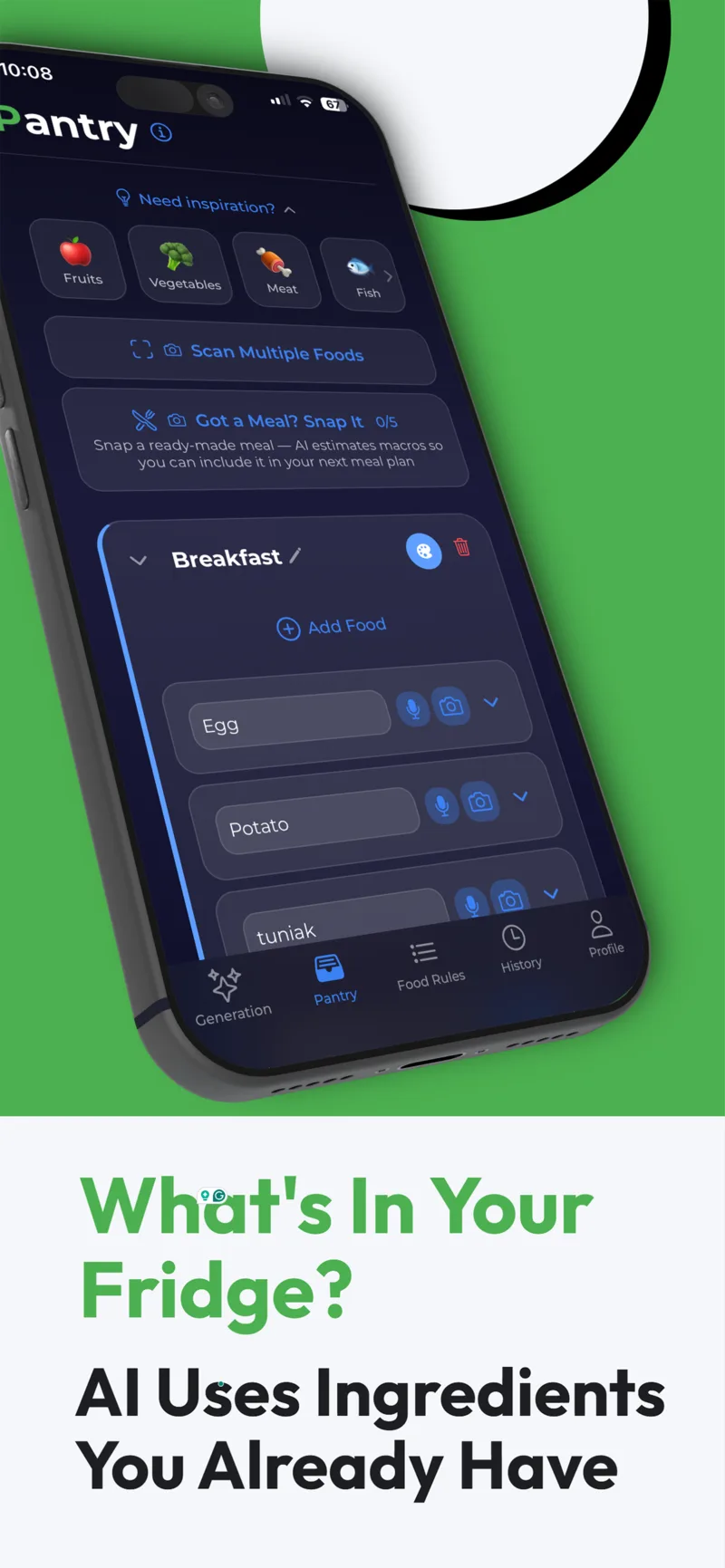
TL;DR: Family meal planning fails for three reasons: picky eaters, decision fatigue, and food waste. An AI meal planner fixes all three at once. You inventory your pantry, set per-person Food Rules (allergies, dislikes, dietary restrictions), and generate a 7-day multi-day plan that scales to family size and produces a single aggregated shopping list. Realistic results: 60–90 fewer minutes of weekly planning, $150–300/month saved on groceries and takeout, and far less food thrown away. Free tier gives you 7 plans to test it on your actual family.
Quick Answer: What is a family meal planner?
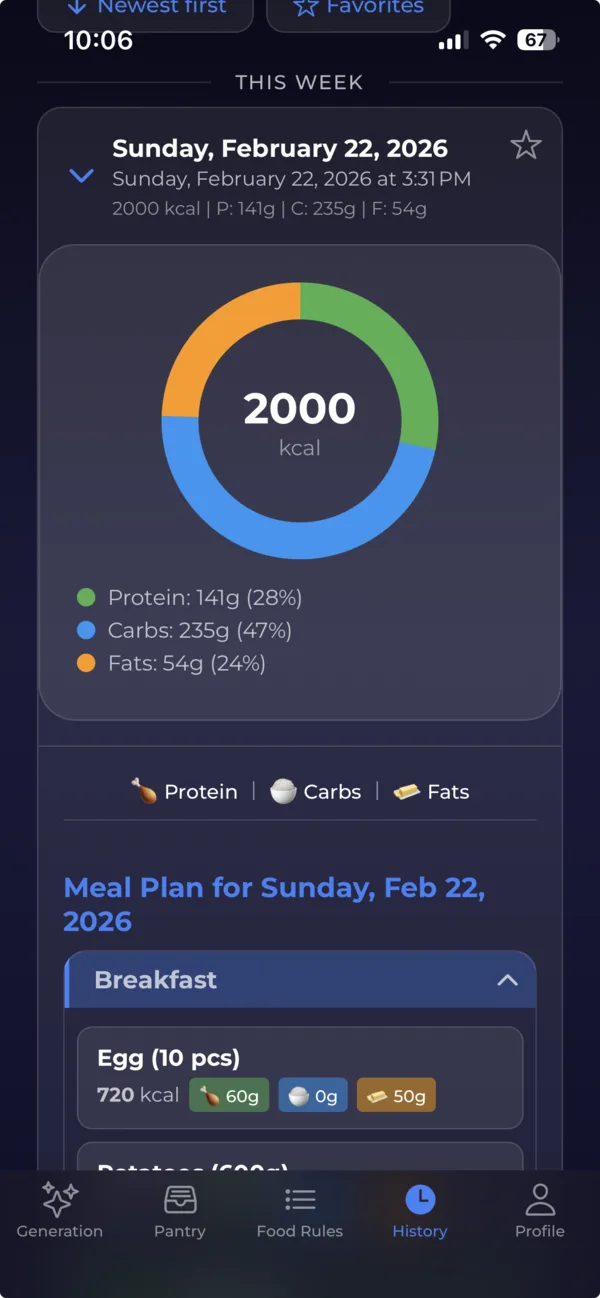
A family meal planner is a tool that builds weekly meal plans for an entire household at once — handling family-sized portions, multiple dietary restrictions per person, kid-friendly meals, and a shared shopping list. An AI-powered family meal planner like Qedamio adds three things on top of a regular meal planner: it uses what is already in your pantry first (cutting waste), it accepts per-person Food Rules so picky eaters and allergies are respected automatically, and it aggregates ingredients from 7 days of meals into a single shopping trip. The output is a complete week of breakfasts, lunches, and dinners with exact portions and macros for the adults.
Family meal planning by the numbers:
• 30–40% of food a household buys is wasted (USDA ERS, 2024)
• $1,500/year — average value of food thrown out by a family of four (USDA)
• $270–330/week — typical U.S. grocery spend for a family of four (BLS Consumer Expenditure, 2024)
• 60–90 minutes/week — time the average parent spends planning meals manually
• 5–6 hero ingredients — the rotation that keeps a week's meals varied and cheap
• 21 meals/week — what a 7-day breakfast/lunch/dinner plan covers for one person
• 3–5× — cost multiplier of takeout vs. home-cooked equivalent meals
• $150–300/month — realistic family savings from pantry-first planning
In this guide:
→ Why Family Meal Planning Usually Fails
→ How AI Family Meal Planning Works
→ Picky Eaters — The Right Way to Handle Them
→ Kids and Macros — What to Track and What to Skip
→ Sample 7-Day Family Meal Plan (Family of 4)
→ Family Food Rules That Actually Stick
→ Batch Cooking and the Sunday-Hour Rule
→ From Plan to Shopping List in One Tap
→ Manual Planning vs AI — Side-by-Side
→ Plans by Family Type (Couples, Toddlers, Teens, Mixed Goals)
→ Family Meal Planning by Diet Pattern
→ Common Family Meal Planning Mistakes
→ Frequently Asked Questions
Free tier — what you get:
• 7 lifetime AI meal plan generations (no credit card required)
• Unlimited pantry items across unlimited custom sections
• 3 custom Food Rules — perfect for testing one allergy or dislike per family member
• Monthly calorie & macro calculator for the adults (BMR / TDEE)
• Full meal plan history with search, favorites, and calendar assignment
Why Family Meal Planning Usually Fails
Most parents have tried meal planning at least once. Most stop within three weeks. The failure pattern is consistent across every family we have heard from, and it has nothing to do with willpower — it is about the structure of the task.
1. Decision Fatigue
Planning 21 meals a week for 3–4 people, each with slightly different preferences, while also tracking macros and a budget, is genuinely cognitively expensive. After a long workday, the brain that has to decide "what is for dinner" is the same brain that has been making decisions all day for everyone else. The default fallback is takeout or "kids eat cereal again."
2. The Picky Eater Trap
Cooking three different meals so everyone is happy works for about a week, then collapses. Cooking one meal that everyone hates collapses faster. The sustainable middle — one base meal with customizable add-ons — takes planning that most people do not have the bandwidth for after work.
3. Pantry Drift
Families accumulate. The pantry holds 6 cans of tomatoes, 3 boxes of pasta, lentils from last winter, and a quinoa nobody likes. The freezer has chicken thighs from two months ago. None of it gets used because no one remembers it is there. The next grocery trip duplicates half of it. The USDA estimates 30–40% of household food is wasted — for a family of four, that is roughly $1,500/year thrown into the bin. (See also our guide on reducing food waste.)
4. Schedule Collisions
Soccer Tuesday, late meeting Wednesday, sleepover Friday. Static "Monday is meatloaf" plans break the second the schedule moves. Plans that survive a real family week have to assume disruption is the default, not the exception.
5. The Spreadsheet Problem
Manually building a week's meal plan in a spreadsheet or notebook takes 60–90 minutes. Doing it weekly is unsustainable. Doing it once and then trying to repeat the same week forever leads to revolt. The activity itself has to take 5 minutes or it does not get done.
An AI family meal planner directly attacks all five failure modes: it removes the decision (one tap generates the plan), respects the picky-eater layer through Food Rules, uses pantry-first inventory so nothing drifts, supports calendar assignment so meals can move when the schedule does, and compresses the planning task from 90 minutes to under 5.
How AI Family Meal Planning Works
The Qedamio workflow for a family is the same as for an individual user, with two extra steps: per-person Food Rules and family-sized portions. Here is the full loop:
Step 1 — Pantry Inventory (10 minutes, once)
Walk through the kitchen with the app open. Add everything — pantry shelves, fridge proteins, freezer items, condiments, baking supplies. Voice input handles long lists in under a minute ("eggs, milk, butter, two pounds chicken thighs, frozen broccoli, frozen peas..."). Image recognition lets you scan a fridge shelf or pantry corner. From this point on, the AI will only build plans from this inventory.
Step 2 — Family Food Rules (5 minutes, once)
Set up rules at the household level. Examples that show up in real family setups:
- Allergies (must avoid): "No peanuts", "No shellfish", "No tree nuts", "No sesame"
- Strong dislikes: "No mushrooms", "No olives", "No fish", "No spicy food"
- Dietary patterns: "Vegetarian for teen #1", "Lactose-free for parent", "No pork"
- Structural rules: "Include vegetables in every dinner", "Minimum 25g protein per adult dinner", "No raw seafood for kids"
- Schedule rules: "Quick weeknight meals (under 30 min)", "Slow-cook on Sundays only"
The AI respects these on every single plan. You set them once and forget about them.
Step 3 — Adult Macro Targets (2 minutes)
Use the built-in calorie and macro calculator for the adults in the household. Kids do not need explicit macro targets — see the kids section below for why. The targets the AI uses are typically the higher-calorie adult's needs (the parent who eats more), with kids served the same food in age-appropriate portions.
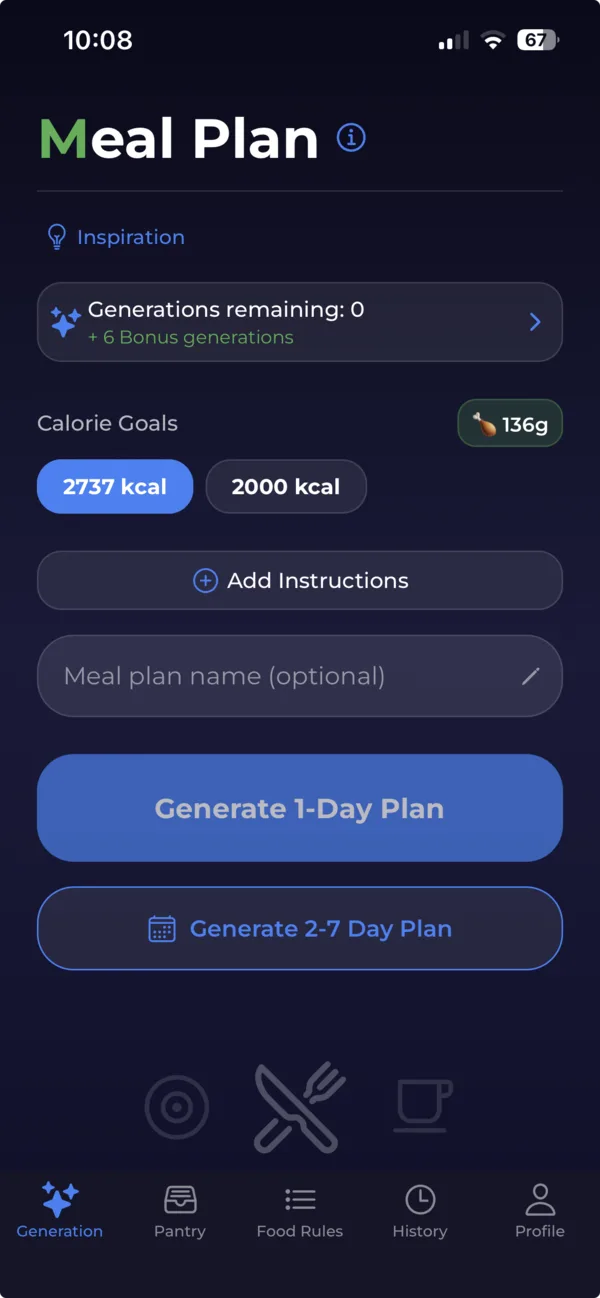
Step 4 — Generate a Multi-Day Plan
Tap generate and pick the number of days (most families pick 5 or 7). The AI produces breakfasts, lunches, and dinners for each day, scaled for family-sized cooking, respecting all Food Rules, and using strictly what is in your pantry. Every meal has exact portions and per-meal macros for the adults.
Step 5 — Calendar and Shopping List
Two outputs come automatically: a calendar view where you can drag meals to specific days (so Tuesday's quick stir-fry can swap with Sunday's slow-cook if the schedule changes), and a single aggregated shopping list with only the items you do not already have. PDF export and email sharing are built in for partners or co-parents who do the shopping.
That is the whole loop. After the first 15–20 minute setup, the recurring weekly task is roughly: re-inventory anything new from yesterday's grocery run (1 minute), tap generate (10 seconds), drag meals to days that fit your week (1 minute), share the shopping list with your partner. Total weekly time: under 5 minutes.
Try It On Your Actual Family — Free
7 free AI meal plan generations — enough to plan a full week and a few extras. No credit card. No trial clock. Inventory once, set your family rules, generate.
Picky Eaters — The Right Way to Handle Them
This is the single biggest blocker to family meal planning. Two strategies work in practice, and one strategy fails predictably.
What Fails: Three Separate Dinners
Cooking a different meal for each family member is the most common trap. Parents start strong — baked chicken for one kid, pasta for another, salmon for the adults. Within 2–3 weeks, the time and stress cost compounds, and the family ends up either back on takeout or eating the same five meals in rotation. Tracking macros and budget across three separate meals per night is also functionally impossible.
What Works: Common Base + Customizable Add-Ons
Build dinners around a base that everyone tolerates: rice, pasta, tortillas, baked potatoes, sheet-pan vegetables, scrambled eggs, ground meat. Then let each family member customize their own plate from a small set of add-ons. The cooking time is the same as one dinner, but the kid who refuses peppers picks corn instead, the teen on a cutting plan adds extra chicken, and the parent with high blood pressure skips the cheese. One meal, four happy plates.
Examples that work for almost every family:
- Taco night: Cook seasoned ground meat or beans. Set out tortillas, rice, lettuce, tomato, cheese, sour cream, salsa, avocado. Each person builds their own.
- Pasta night: One pasta, one base sauce. Toppings: parmesan, chicken, vegetables, chili flakes, extra olive oil. Everyone scales their own portion.
- Sheet-pan chicken & vegetables: One pan, three vegetables, one protein. Each person picks which two of the three vegetables they want.
- Stir-fry with rice: Cook rice and a base protein. Set out cooked vegetables separately. Each plate gets the vegetables that person eats.
- Breakfast for dinner: Eggs (any style), toast, sausage or beans, fruit. Universally accepted.
What Also Works: Per-Person Food Rules
For hard exclusions — allergies, dietary patterns, deeply rooted dislikes — set a Food Rule per person. The AI excludes those ingredients from any meal that person will eat. This is structurally different from "they will not eat it" — the AI never even generates the meal. Examples:
- "Kid #1 — no nuts (allergy)"
- "Kid #2 — no fish, no mushrooms"
- "Teen — vegetarian"
- "Parent A — lactose-free"
- "Parent B — cutting (lower carb evenings)"
The plan that comes out has accounted for all of them automatically. No more checking ingredient lists at 6 PM.
The Slow Exposure Layer
Once the picky-eater problem is structurally solved, you have bandwidth to actually expand kids' palates. Plate 1–2 small portions of a new vegetable next to known foods, no pressure to eat it. Repeat for several weeks. AAP-aligned guidance shows it can take 10–15 neutral exposures before a kid accepts a new food. This works because the rest of the meal is already handled — you are no longer fighting hunger and a 7 PM deadline at the same time.
Kids and Macros — What to Track and What to Skip
Important: This article is not medical advice. Children's nutrition needs vary by age, sex, growth stage, and individual health. Always consult your pediatrician or a registered dietitian for child-specific guidance — especially for kids managing allergies, diabetes, or growth concerns.
Adults: Track Macros Normally
For adults in the household, use the same macro framework you would use without a family. Calculate TDEE, set protein at 1.6–2.2g/kg if you are training (see high-protein meal planner), and let the AI build meals that hit your daily targets. For deeper macro detail by goal, the macro meal planner guide covers protein/carb/fat splits across cutting, maintenance, and bulk. The presence of kids in the meal does not change the adult math — it just changes the form of the food.
Kids: Skip Strict Macro Tracking
The American Academy of Pediatrics and most pediatric dietitians do not recommend macro counting for healthy children. Kids' caloric and protein needs scale with age and growth in ways that do not fit neatly into adult macro frameworks. The recommended approach is "responsive feeding" — serve balanced meals (a protein, a carb, a vegetable, a fat) in age-appropriate portions, and let the child self-regulate intake within those choices.
Practical implementation: serve kids the same family meal in smaller portions. A 7-year-old eats roughly half the adult portion of the protein and carbs, with the same vegetables and fats. A 12-year-old going through a growth spurt may eat the same portion as the adult. The AI plan covers the cooking quantity for the household; you portion plates at the table.
Special Cases (See a Pediatrician)
For children with celiac disease, type 1 diabetes, severe food allergies, eating disorders, or growth concerns, do not improvise nutrition planning from a general-purpose meal planner. Use the AI to generate the family's base meal structure, then have a pediatric dietitian review or adjust for the specific child. Food Rules can encode their dietary requirements (e.g. "gluten-free for kid #1", "no added sugar"), but a clinician should verify the resulting plan covers their specific needs.
Sample 7-Day Family Meal Plan (Family of 4)
An illustrative week for a family of four with two adults (one parent in a slight calorie deficit, one in maintenance), one 9-year-old, and one 14-year-old. Built around 6 hero ingredients: chicken thighs, ground beef 80/20, eggs, rice, pasta, frozen mixed vegetables. One Food Rule: "No mushrooms" (kid #1).
| Day | Breakfast | Lunch | Dinner |
|---|---|---|---|
| Sun | Scrambled eggs, toast, fruit | Sandwich + apple (light, batch-cook later) | Sheet-pan chicken thighs + rice + roasted vegetables (cook double for tomorrow's lunch) |
| Mon | Oatmeal + banana + peanut butter | Leftover sheet-pan chicken & rice bowls | Spaghetti bolognese (ground beef, tomato sauce, pasta) + side salad |
| Tue | Greek yogurt + granola + berries | Leftover bolognese (kids), bolognese stuffed peppers (adults) | Taco night — ground beef, tortillas, rice, lettuce, cheese, salsa (build-your-own) |
| Wed | Eggs on toast + orange | Taco leftovers wrapped in tortillas | Chicken stir-fry with rice and frozen mixed vegetables (quick, 25 min) |
| Thu | Oatmeal + banana | Stir-fry leftovers | Pasta carbonara (eggs, bacon or ham, parmesan) + green beans |
| Fri | Greek yogurt + honey + walnuts (skip nuts for kid #1) | School/work sandwiches + carrots | Breakfast for dinner — pancakes, eggs, fruit, sausage |
| Sat | Pancakes (leftover) or eggs | Family lunch out OR easy sandwiches at home | Slow-cooked chili (ground beef, beans, tomatoes, cumin) over rice + cornbread |
Why this week works:
- Hero rotation: Chicken thighs (Sun, Wed), ground beef (Mon, Tue, Sat), eggs (Mon, Wed, Thu, Fri), rice (Sun, Mon, Tue, Wed, Sat), pasta (Mon, Thu), frozen vegetables (everywhere). 6 ingredients, 21 meals.
- Two batch cooks: Sunday sheet-pan covers Sunday dinner + Monday lunch. Saturday chili covers Saturday + Sunday next week. Total Sunday cooking: 1 hour.
- Kid customization: Taco night and breakfast-for-dinner are universal hits. Bolognese is plain pasta for kids, stuffed peppers for adults — same protein, different presentation.
- Schedule slack: Wednesday and Thursday are 25-minute weeknight meals. Friday is the lowest-effort day (everyone eats pancakes). Saturday is the slow-cook because nobody is rushed.
- Adult macros: The deficit parent gets a smaller portion of rice/pasta and the same protein. The maintenance parent eats the full portion. The teen typically eats the adult portion. The 9-year-old eats roughly half of an adult's carb/protein with the same fats and vegetables.
The AI generates a week like this in 30 seconds, then you tweak: swap the Friday pancakes for waffles if you prefer, move the Saturday chili to Sunday if you have an event Saturday, etc. The shopping list compiles automatically and excludes everything already in the pantry.
Family Food Rules That Actually Stick
Food Rules are where families who succeed long-term differ from families who give up. The trick is to set rules that are structural — they make planning easier, not harder — rather than aspirational rules nobody follows.
Rules That Work
- "Two vegetables in every dinner" — structural, easy to enforce, kids learn to expect them.
- "No mushrooms / no peanuts / no fish" — per-person dislikes and allergies. Hard exclusions the AI respects every time.
- "Quick weeknight meals (under 30 min)" — matches reality. Slow-cook only on weekends.
- "Use what is open first" — if a jar of pasta sauce is open, the AI plans a meal that uses it before opening a new one.
- "One leftover night per week" — prevents waste, gives the cook a day off.
- "Friday is easy night" — structurally low-effort meal (pizza, breakfast-for-dinner, leftovers).
- "Minimum 25g protein per adult dinner" — ensures the parents in a fitness goal are actually hitting macros.
Rules That Fail
- "Kids must eat what is served" — sets up daily power struggles. Use base + add-ons instead.
- "No carbs after 6 PM" — rarely sustainable for a household with kids who need carbs for growth.
- "All organic, all from-scratch" — aspirational, collapses under real schedule pressure.
- "Three different meals per dinner" — the picky-eater trap discussed above.
- "Track every macro for everyone" — not appropriate or useful for kids.
Free tier supports 3 Food Rules — enough to encode the most important family-specific exclusions. Medium and Pro tiers support unlimited rules, which becomes useful once you have 4+ household members each with their own preferences.
Batch Cooking and the Sunday-Hour Rule
The single biggest force multiplier on family meal planning is one hour of batch cooking on Sunday (or whatever your slow day is). One hour of focused work covers 5–7 weeknight dinners. The math is dramatic.
What to Batch Cook
Items that hold up 4–5 days in the fridge or freeze well:
- Cooked grains: Rice (5–6 cups cooked), pasta, quinoa, bulgur. Reheat with a splash of water.
- Roasted proteins: Whole chicken, sheet-pan chicken thighs, meatballs, hard-boiled eggs (10–12).
- One large batch dish: Chili, bolognese, dal, lentil soup, beef stew, tomato sauce. Covers 2 dinners + 2 lunches easily.
- Roasted vegetables: Cauliflower, broccoli, sweet potatoes, peppers, onions. Reheat in the oven for 5 min to recrisp.
- Sauces and dressings: One pesto, one vinaigrette, one yogurt sauce. Transform leftovers into different meals.
What Not to Batch Cook
- Crunchy vegetables (lettuce, raw peppers) — chop fresh.
- Anything fried or breaded — loses texture.
- Cream-based pasta sauces — separate when reheated.
- Avocado anything — oxidizes.
The Sunday-Hour Setup
A practical Sunday hour: oven at 400°F. Sheet-pan one whole chicken or 6 thighs (45 min, hands-off). On the stove: large pot of rice (20 min) and one batch dish like chili or bolognese (40 min, mostly simmer). On a second sheet pan: roasted vegetables (30 min). Hard-boil 12 eggs in a small pot. Total active hands-on time: about 60 minutes. Output: protein for 5 dinners, carbs for 7 meals, vegetables for 4–5 meals, eggs for breakfasts.
The AI's meal prep mode generates plans optimized for this workflow — meals that share ingredients and benefit from being batch-cooked once.
From Plan to Shopping List in One Tap
The shopping list is where most manual meal planners break down. You have 21 meals across 7 days, each meal lists 5–8 ingredients, and many ingredients overlap. Manually compiling this takes 20–30 minutes and is the part of meal planning people skip most often.
Qedamio aggregates ingredients across the entire multi-day plan into a single shopping list, automatically subtracts what is already in your pantry, groups items by store section (produce, dairy, frozen, pantry, meat), and lets you check off items as you shop. Two practical things this enables:
- One trip per week. Mid-week "I forgot something" trips destroy budgets — you go in for milk and walk out with $40 of impulse buys. A complete weekly list cuts these to near zero.
- Co-parent sharing. Export to PDF or email and send to whoever does the shopping. The list is the same one the AI used to plan, so nothing gets missed.
If you regularly cook the same kinds of meals, the shopping list also doubles as a pattern detector — you start noticing that certain staples (eggs, oats, rice, frozen vegetables, chicken) are always on the list, and you can buy them in bulk to save further. See the cheap meal planner guide for bulk-buying strategies that compound with family-size purchasing.
Manual Planning vs AI — Side-by-Side
The single biggest reason family meal planning fails is the time cost of doing it manually. Here is how the two workflows actually compare on a typical week:
| Step | Manual Planning | Qedamio AI |
|---|---|---|
| Check pantry & fridge | 10–15 min, easy to miss items | 1 min update from saved inventory |
| Decide 21 meals | 30–45 min of decision fatigue | 10 seconds — one tap |
| Track allergies/dislikes | Held in your head, easy to forget | Per-person Food Rules enforced automatically |
| Hit adult macros | Calculator + manual estimate per meal | Calculated automatically, per-meal breakdown |
| Compile shopping list | 15–25 min of cross-referencing | Auto-aggregated, pantry-deducted |
| Schedule meals to days | Sticky notes, fridge whiteboard | In-app calendar, draggable |
| Share with co-parent | Photo of paper list, hard to update | PDF / email export from app |
| Total weekly time | 60–90 minutes | Under 5 minutes |
| Direct cost | Free (but high time cost) | Free tier (7 lifetime plans) or $9.99/mo (31 plans) |
The economic case is clear once you put a number on the time saved. Even at minimum wage, 60 minutes of weekly planning is roughly $30/month of opportunity cost. The Medium tier is $9.99 for 31 plans and removes that hour entirely — alongside the $150–300/month in grocery savings from pantry-first planning.
Solve Tonight's Dinner in 60 Seconds
Skip the 6 PM panic. Open the app, tap generate, get a kid-friendly dinner that hits adult macros and uses what is already in your fridge. 7 free generations — enough for a full week.
Plans by Family Type
Couples (Two Adults, No Kids)
The simplest family case. Two adults, often with different goals (one bulking, one maintaining; one vegetarian, one omnivore). Strategy: one base meal, two portion sizes. Set Food Rules per person if dietary patterns differ. A 7-day plan with batch cooking on Sunday gives you takeout-free weeknights for ~2 hours of total weekly cooking.
Families with Toddlers (1–4 Years)
Toddlers eat in tiny portions and have strong, unpredictable preferences. The base + add-ons strategy is essential. Food Rules should include any allergens being introduced cautiously and any choking hazards (whole nuts, raw carrots, hard candies). Portion the toddler's plate from the same family meal, with knife-cuts and finger-food adaptations as needed. Macros are not the focus — balanced meals and exposure to new foods are.
Families with School-Age Kids (5–12 Years)
Peak picky-eater years. Base + add-ons is non-negotiable. Lunch box planning is its own sub-problem — the AI can include packed lunch suggestions in the multi-day plan, which usually means leftovers from the previous night plus a fruit and a small snack. Calendar assignment is genuinely useful here because school activities scramble the week.
Families with Teens (13–19 Years)
Teens eat almost as much as adults, often more during growth spurts, and frequently have their own dietary preferences (plant-based, performance-focused, high-protein for sports). Treat them as a separate "macro person" with their own targets if they are tracking, and as an extra adult portion if they are not. Per-person Food Rules become very useful here.
Mixed-Goal Families
Common scenario: one parent bulking for muscle, one parent in a weight-loss deficit, kids growing. The single-meal-multiple-portions approach handles all three. The bulking parent adds an extra carb scoop and a tablespoon of olive oil to their plate. The cutting parent eats the same protein with smaller carb and more vegetable. Kids eat age-appropriate portions. See bulking and deficit guides for the macro details on each side.
Single-Parent Households
Time is the binding constraint. The Sunday-hour rule is even more valuable here, and the goal is to minimize weeknight cooking to under 20 minutes per meal. Set a Food Rule "Quick weeknight meals only (under 25 min)" and let the AI handle complexity reduction. Multi-day plans are particularly valuable — one decision covers a week of dinners. See the busy people meal planner for time-optimized strategies.
Family Meal Planning by Diet Pattern
Most diet patterns scale to a family with one adjustment: cook the base meal that fits the diet, and serve kids age-appropriate portions of the kid-friendly components. Here is how each pattern translates to family use:
- Family Mediterranean diet: Olive oil, fish, legumes, whole grains, vegetables. Naturally kid-friendly because pasta, bread, and chicken are all on-pattern. See the Mediterranean meal planner for the full framework.
- Family vegetarian/vegan: Lentils, beans, tofu, eggs (vegetarian only), dairy (vegetarian only), whole grains. Watch B12 and iron for kids on full vegan; pediatrician check is recommended. See the vegan meal planner.
- Family high-protein: When parents are training and want to keep the household in step, focus on eggs, chicken, Greek yogurt, cottage cheese, and lean ground meat. Kids eat the same proteins in smaller portions. See high-protein meal planner and high-protein foods guide.
- Family low-carb / keto: Generally not recommended for growing children without medical supervision. Adults can run keto while kids eat normal carbs at the same meal — rice/potato on the side that adults skip. See keto meal planner for adult-only keto plans.
- Family budget eating: Same hero ingredients (eggs, chicken thighs, rice, oats, beans, frozen vegetables) scale linearly to family size with bulk-buying advantages. See the cheap meal planner.
- Family intermittent fasting: Adults can run IF schedules while serving kids three normal meals plus snacks. Kids should not skip meals. See intermittent fasting meal plan for adult-only schedules.
For a side-by-side comparison of family-friendly meal planning apps, see our meal plan generator comparison.
Common Family Meal Planning Mistakes
Editor's note: Across the family meal plans generated by Qedamio users and the broader peer-reviewed literature on household nutrition, six failure patterns repeat. These are the structural reasons family meal planning collapses, with the fixes that actually work.
1. Cooking Three Different Meals Per Dinner
Already covered above — the single most common collapse pattern. Replace with base + add-ons immediately.
2. Tracking Macros for Kids
Counter-productive for healthy children, can encourage disordered eating relationships with food long-term. Track macros for adults; serve balanced meals to kids.
3. Over-Buying Fresh Produce
"We need to eat more vegetables" leads to a fridge full of wilting greens. Frozen vegetables are 40–60% cheaper, often more nutritious (frozen at peak ripeness), and never spoil. Set a Food Rule "Default to frozen vegetables" for school-night dinners.
4. Skipping the Pantry Inventory
Generating a meal plan without telling the AI what you already have is the same as starting a recipe from scratch every time — you end up at the store buying duplicate ingredients while the original ones rot in the back of the pantry. The 10-minute setup is the most important step.
5. Aspirational Rules
"All organic, no processed food, all from-scratch sourdough on Sundays." These rules collapse the first week of the school year. Set rules that match real life, not Pinterest. Frozen vegetables, store-brand pasta, and a microwave reheat at lunch are not failures — they are sustainability.
6. Planning Without the Calendar
A static "Monday is meatloaf" plan dies the first time soccer practice runs late. Use calendar assignment so meals can move when the schedule does. Slow-cooks belong on weekends, sheet-pan dinners on busy weeknights, leftovers on the day after a batch cook.
Key Takeaways:
• Family meal planning fails because of decision fatigue, picky eaters, pantry drift, schedule collisions, and the time cost of manual planning — not willpower.
• The fix is structural: pantry inventory, per-person Food Rules, base + add-ons meal pattern, calendar assignment, and AI generation that takes under 5 minutes weekly.
• Cook one base meal, customize plates per person. Cooking three separate meals per dinner is the most common failure mode.
• Track macros for adults. Serve balanced age-appropriate portions to kids without macro tracking. See your pediatrician for child-specific concerns.
• One hour of Sunday batch cooking covers 5–7 weeknight dinners. This is the highest-leverage hour in any family's week.
• A pantry-first multi-day plan with one aggregated shopping list realistically cuts $150–300/month from a family's grocery and takeout spending.
Frequently Asked Questions
What is the best meal planner for families?
A good family meal planner scales to family size, accepts per-person Food Rules (allergies, dislikes, dietary restrictions), uses what you already have in the pantry to cut waste, and produces one aggregated shopping list. Qedamio is built for exactly this loop — inventory, rules, multi-day plan, shopping list — and the Free tier covers 7 generations to test it on your family before paying anything.
How do you meal plan for a family of four?
Inventory the pantry, set 3–5 family Food Rules (any allergies, biggest dislikes, weeknight time limits), generate a 5–7 day multi-day plan, then assign meals to specific days based on the schedule. Plan one Sunday-hour batch cook covering 2 proteins + 1 batch dish + roasted vegetables. Use the aggregated shopping list for one weekly grocery trip.
How much can families save with meal planning?
Realistic savings are $150–300/month for a family of four, mostly from reduced food waste (USDA data shows households waste 30–40% of what they buy, ~$1,500/year for a family of four) and reduced takeout. The savings come from pantry-first planning + one weekly shopping trip + batch cooking that prevents the "order something quick" loop on busy weeknights.
How do you handle picky eaters in a family meal plan?
Use a common base (rice, pasta, tortillas, baked potatoes, scrambled eggs) and let each person customize their plate from a small set of add-ons. Set per-person Food Rules for hard exclusions (allergies, deep dislikes). Avoid cooking three separate dinners — it collapses within 2–3 weeks every time.
Should kids follow the same macro targets as adults?
No. The American Academy of Pediatrics does not recommend macro tracking for healthy children. Serve kids the same family meal in age-appropriate portions and let them self-regulate intake within balanced choices. Track macros for the adults in the household. For specific concerns (allergies, growth, medical conditions) consult a pediatrician or registered dietitian.
How long does meal planning take for a family per week?
Manual planning: 60–90 minutes per week. With an AI meal planner using a pre-built pantry inventory: under 5 minutes per week (1 minute to update inventory, 10 seconds to generate, ~3 minutes to drag meals to specific days based on the schedule). Batch cooking adds 1 hour on Sunday but saves 5–7 weeknight cooking sessions.
Can I use one meal plan for the whole family if we have different goals?
Yes. Cook one base meal, scale portions per person at the table. The cutting parent gets a smaller carb portion. The bulking parent adds extra rice and a tablespoon of olive oil. Kids eat age-appropriate portions without macro tracking. Cooking three separate dinners is unsustainable; one meal with portion adjustments is.
Do family meal planners handle food allergies?
A good one does, with per-person Food Rules. Qedamio supports unlimited Food Rules per household so each member can have their own restrictions (e.g. "no peanuts for kid #1", "lactose-free for parent"). The AI excludes those ingredients from any meal that household member is intended to eat. For severe allergies, always cross-check the generated ingredient list and consult an allergist or dietitian.
What is a good weekly meal plan for a family of four?
Rotate 5–6 hero ingredients (chicken, ground beef, eggs, rice, pasta, frozen vegetables) across breakfasts, lunches, and dinners. Plan one batch-cook day, one leftover night, and one easy night (breakfast for dinner, sandwiches, or pizza). Mix slow-cooks on weekends with 25-minute weeknight meals. See the sample 7-day plan above for the full breakdown.
References
- U.S. Department of Agriculture, Economic Research Service. "Food Waste FAQs." Accessed 2026.
- American Academy of Pediatrics. "Bright Futures: Nutrition." 4th Edition, 2020.
- U.S. Bureau of Labor Statistics. "Consumer Expenditure Survey — Food." 2024.
- Birch LL, Doub AE. "Learning to eat: birth to age 2 y." Am J Clin Nutr. 2014;99(3):723S-728S.
- Satter E. "Eating competence: definition and evidence for the Satter Eating Competence Model." J Nutr Educ Behav. 2007;39(5 Suppl):S142-53.
- Wansink B, Just DR, Payne CR. "Mindless eating and healthy heuristics for the irrational." Am Econ Rev. 2009;99(2):165-169.
- FAO. "The State of Food and Agriculture 2019: Moving forward on food loss and waste reduction."
← Back to AI Meal Planner · Meal Planning Statistics 2026 · Related: Weekly Meal Planning Guide · Meal Prep Planner · Busy People Planner · Cheap Meal Planner · Pantry Meal Planner · Reduce Food Waste
Disclaimer: This article is general information about family meal planning and is not medical or nutritional advice. Children's nutritional needs vary by age, sex, growth stage, and individual health. Always consult your pediatrician or a registered dietitian for child-specific dietary guidance, especially for children managing allergies, diabetes, eating disorders, or growth concerns. Adult macro recommendations cited here apply to generally healthy adults; individuals with medical conditions should seek personalized guidance from a qualified healthcare provider.